
Learn how to properly substitute honey for sugar in baking. Baking with honey is a great way to add moisture and flavor that sugar can't just match, but it can also be a little tricky.
Whether you are looking for a natural alternative to refined sugar or you simply ran out of sugar mid-recipe, you can't just do a simple swap. Because honey is sweeter, acidic, and holds more moisture than sugar, it can easily ruin the texture of your baked goods if you do not know all the rules. In this post, I'll break down the exact science, the simple conversion ratios and my pro-tips for getting the perfect bake with honey every time.
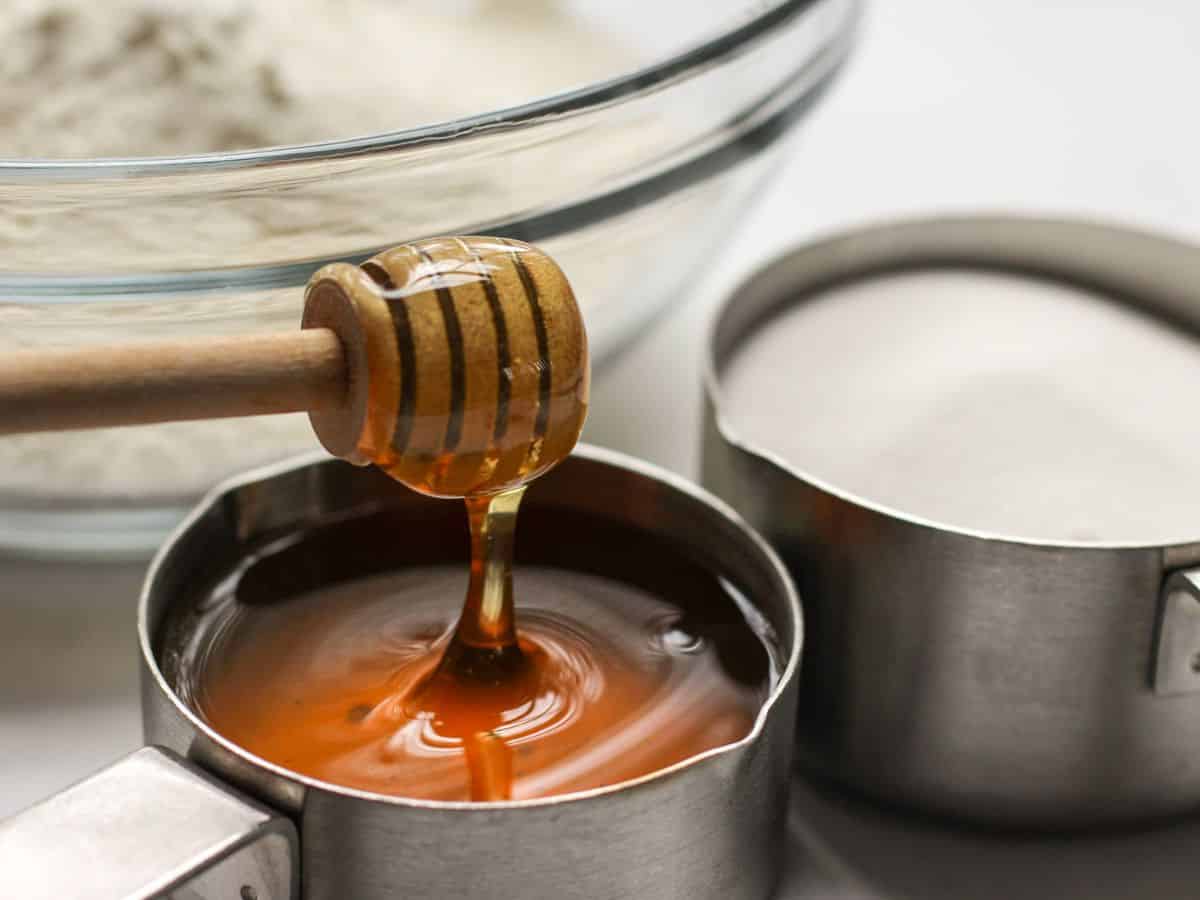
Can you substitute honey for sugar in baking?
The short answer is yes. But you cannot do just 1:1 swap. Honey is liquid and acidic. It is also sweeter than sugar. So you will need to make other adjustments to the recipe, which I explain below. When you use honey in place of sugar in baking, your batters will be heavier and brown faster.
Honey to sugar conversion guide
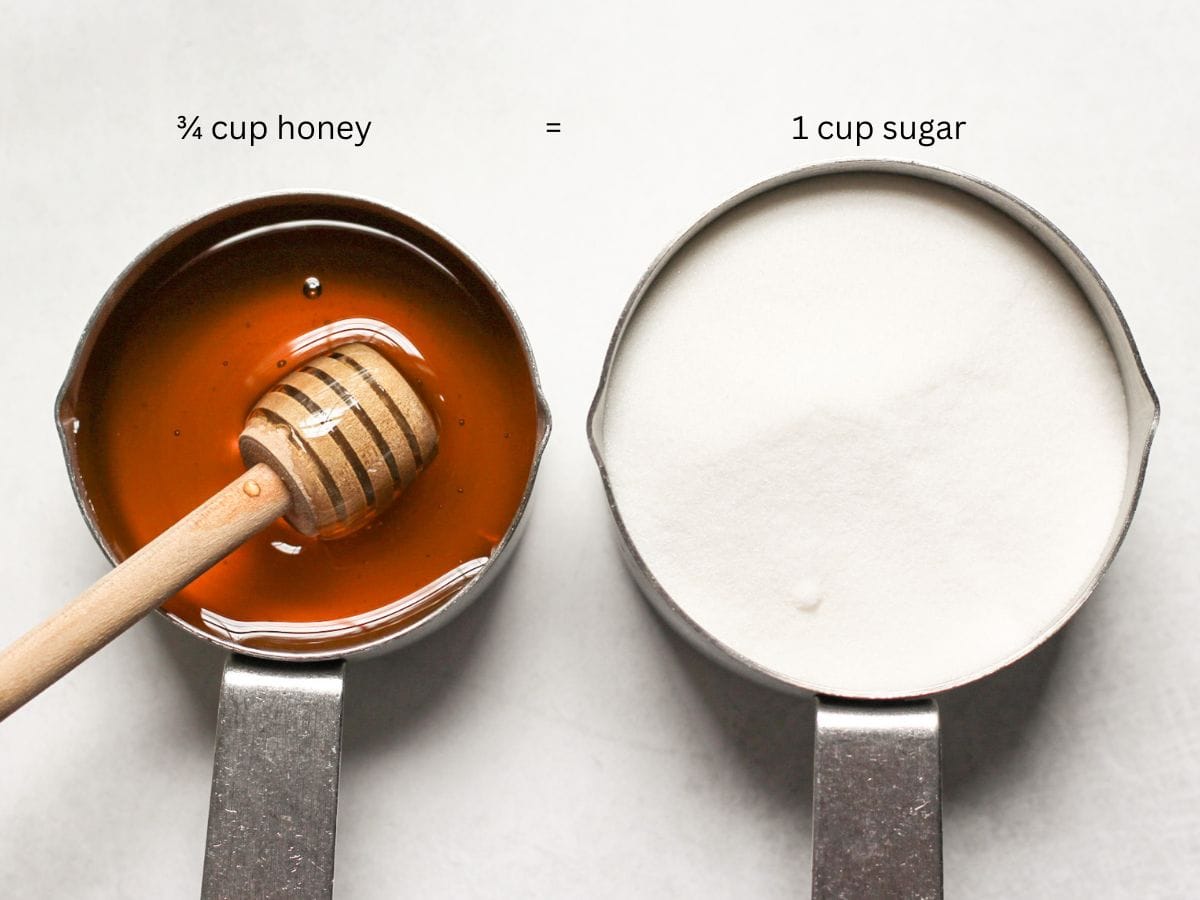
The general rule for adjusting sugar for honey is to use ¾ cup of honey for 1 cup of sugar. But honey is liquid and acidic, you cannot just simply swap it for any recipe. You will also have to reduce the liquid and add the baking soda. To make it easier, I have created a chart to use:
| if the recipe calls for | use this much honey | reduce liquid by | add baking soda |
| 1 Tablespoon Sugar | ¾-1 Tablespoon* | none | none |
| ¼ Cup Sugar | 3 Tablespoons | by 1 Tablespoon | ⅛ teaspoon |
| ½ Cup Sugar | 6 Tablespoons | by 2 Tablespoons | ¼ teaspoon |
| ¾ Cup Sugar | ½ Cup + 1 Tbsp | by 3 Tablespoons | ½ teaspoon |
| 1 Cup Sugar | ¾ Cup | ¼ Cups | ¾ teaspoon |
Note*: To be mathematically precise for 1 tablespoon of sugar you will need ¾ tablespoons of honey. But if the recipe calls only for 1 tablespoon if sugar, you can simply use 1 tablespoon of honey. Honey is sticky and it can be tricky to measure exactly ¾ Tablespoon. In this case, the difference in sweetness is minor.
Note 2: If your recipe uses buttermilk, lemon juice or other acid ingredients, you may not need adding baking soda at all.
Pro tip: For best results, use a kitchen scale. 1 cup of granulated sugar weighs 200 grams, while ¾ cup of honey weighs about 255 grams.
Which liquid to reduce when using honey?
You probably looked at the chart above and wondered which type of liquid it is best to reduce.
So for every 1 cup of honey, reduce the other liquids by ¼ cup.
The best ones to reduce are milk, cream or water. If those are not part of the ingredients, you can reduce coffee, juice, pureed fruit. And the latest resort are the eggs. Eggs can be tricky to remove as they provide structure.
Do not reduce oil, butter or other fats as are fats (not liquids) and play a big role in baked goods texture.
The science here: Honey is sugar, not a fat. If you reduce the butter or oil to compensate for the liquid texture of honey, you are changing thee fat-to-flour ratio. This will make your baked goods tough and rubber.
How using honey affects baked goods
Using honey in baking changes not just sweetness. It also change the chemistry of your batter or dough. Because honey is a humecant, it naturally retains water. It means that your cakes will stay soft and breads will not get stale for loner days than those made with granulated sugar.
Honey is also more concentrated than sugar, in simple words it is sweeter. It also adds a distinct flavor profile that can vary depending on the type of honey (wild flower, clover, buckwheat etc).
Honey is made of natural sugars (fructose and glucose), so it triggers the Maillard reaction. It means that the baked goods will brown much faster. It results in deeper, golden-brown color and rich flavor, but it also means you need to keep an eye on the baking time to prevent over-browning.
When Not to substitute honey for sugar?
While honey is a versatile sweetener, it does not always work as a substitute for sugar. In some recipes, sugar is not just a sweetener, it is essential for structure. Here is when I think you should skip the honey and stick to regular sugar:
- Crisps and crunchy cookies: If you are dreaming of snap-crisp ginger snap or a thin crunchy wafer, avoid honey. Because honey is humecant, it will not work for crispy and crunchy baked good.
- Light and airy sponges: Recipes that call for creaming sugar and butter or beating eggs and sugar to create air pockets need sugar (not honey). Honey is liquid and cannot hold those air bubbles.
Pro Tip: If you still want that honey flavor for such recipes, but need the structure, it is still possible. Try adding 1-2 tablespoons of honey and keep the rest of the sugar. This is exactly how I developed my honey sponge cake. By beating the eggs and sugar first to create that airy structure, and then gently mixing in that honey to flavor the batter.
- Meringues and pavlovas: The stability of a meringue comes from the way sugar bonds with egg white proteins. Honey us simply too heavy and acidic for this process. The meringue will collapse if you use honey.
- High-heat candy making: Honey has a lower burning point than white sugar. If you try using honey to make caramel or candy, it will likely burn.
4 main rules for baking with honey
If you do not have time to read through the whole article ( I know it is a lot), you can at least make sure to learn about the 4 main rules:
- The conversion ratio. Use ¾ cup of honey for 1 cup of granulated sugar.
- The liquid balance. For every 1 cup of honey added, reduce other liquids by ¼ cup. It can be milk, water, juice or eggs. Do not reduce the fats.
- Adjust the oven temperature. Lower your oven by 25℉ (15C). If the top browns too fast, cover it loosely with foil.
- The acidity. For every ½ cup of honey, add ½ teaspoon of baking soda to neutralize the acid and help the baked good rise.
Frequently asked questions
Yes, you can bake with any type of honey. But keep in mind that the type of honey can change the flavor of your baked good. Clover and wildflower are mild and perfect for general baking. If you use dark honey like Buckwheat, the flavor will be stronger.
Absolutely. If your honey becomes solid or grainy, you can still bake with it. Make it liquid again (easier to measure!) by placing the jar in a bowl with warm for a few minutes.
Lightly coat your measuring cup or a spoon with the neutral oil and your honey will slide out easily.
Lower the oven by 25℉, bake at lower-middle position or cover the cake loosely with aluminum foil.


Comments
No Comments