
Savas Kitchen

  • Home
  • Recipe Index
  • By Category
    • Ukrainian
    • Breakfast
    • Lunch
    • Dinner
    • Side Dishes
    • Soup
    • Sweet treats
  • About
  • Contact
menu icon
go to homepage
  • Recipe Index
  • About
  • Contact
  • Subscribe
    • Facebook
    • Instagram
    • Pinterest
  • search icon
    Homepage link
    • Recipe Index
    • About
    • Contact
    • Subscribe
    • Facebook
    • Instagram
    • Pinterest
  • ×
    Home » How to recipes

    How to Substitute Honey for Sugar in Baking (+Pro Tips)

    Published: Apr 27, 2026 by Nataliia

    Learn how to properly substitute honey for sugar in baking. Baking with honey is a great way to add moisture and flavor that sugar can't just match, but it can also be a little tricky.

    Whether you are looking for a natural alternative to refined sugar or you simply ran out of sugar mid-recipe, you can't just do a simple swap. Because honey is sweeter, acidic, and holds more moisture than sugar, it can easily ruin the texture of your baked goods if you do not know all the rules. In this post, I'll break down the exact science, the simple conversion ratios and my pro-tips for getting the perfect bake with honey every time.
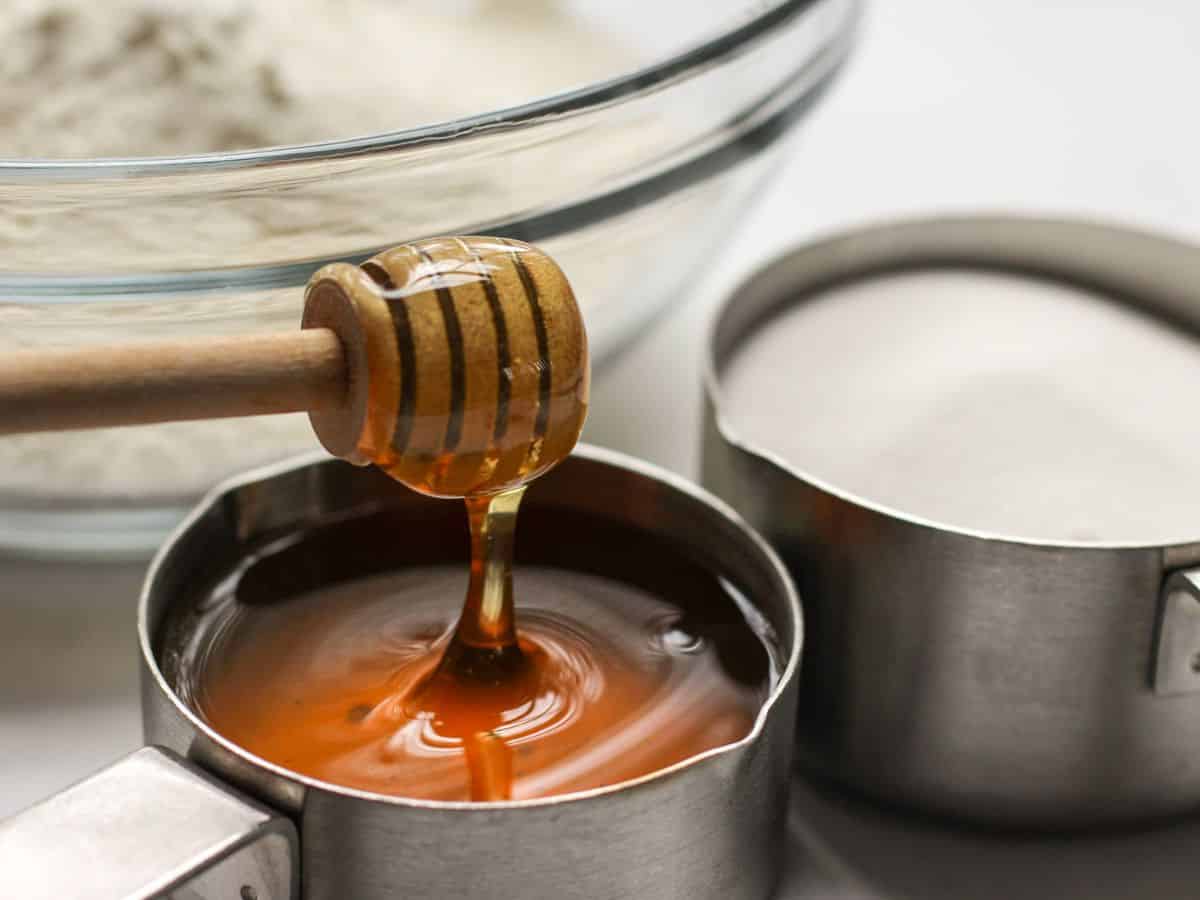
    Measuring cup filled with honey with a wooden honey dipper next to bowl flour and sugar.
    Jump to:
    • Can you substitute honey for sugar in baking?
    • Honey to sugar conversion guide
    • How using honey affects baked goods
    • When Not to substitute honey for sugar?
    • 4 main rules for baking with honey
    • Frequently asked questions
    • My favorite baking with honey recipes
    • 💬 Comments

    Can you substitute honey for sugar in baking?

    The short answer is yes. But you cannot do just 1:1 swap. Honey is liquid and acidic. It is also sweeter than sugar. So you will need to make other adjustments to the recipe, which I explain below. When you use honey in place of sugar in baking, your batters will be heavier and brown faster.

    Honey to sugar conversion guide

    The general rule for adjusting sugar for honey is to use ¾ cup of honey for 1 cup of sugar. But honey is liquid and acidic, you cannot just simply swap it for any recipe. You will also have to reduce the liquid and add the baking soda. To make it easier, I have created a chart to use:

    if the recipe calls for use this much honeyreduce liquid byadd baking soda
    1 Tablespoon Sugar¾-1 Tablespoon*nonenone
    ¼ Cup Sugar3 Tablespoonsby 1 Tablespoon⅛ teaspoon
    ½ Cup Sugar6 Tablespoonsby 2 Tablespoons¼ teaspoon
    ¾ Cup Sugar½ Cup + 1 Tbspby 3 Tablespoons½ teaspoon
    1 Cup Sugar¾ Cup¼ Cups¾ teaspoon

    Note*: To be mathematically precise for 1 tablespoon of sugar you will need ¾ tablespoons of honey. But if the recipe calls only for 1 tablespoon if sugar, you can simply use 1 tablespoon of honey. Honey is sticky and it can be tricky to measure exactly ¾ Tablespoon. In this case, the difference in sweetness is minor.

    Note 2: If your recipe uses buttermilk, lemon juice or other acid ingredients, you may not need adding baking soda at all.

    Pro tip: For best results, use a kitchen scale. 1 cup of granulated sugar weighs 200 grams, while ¾ cup of honey weighs about 255 grams.
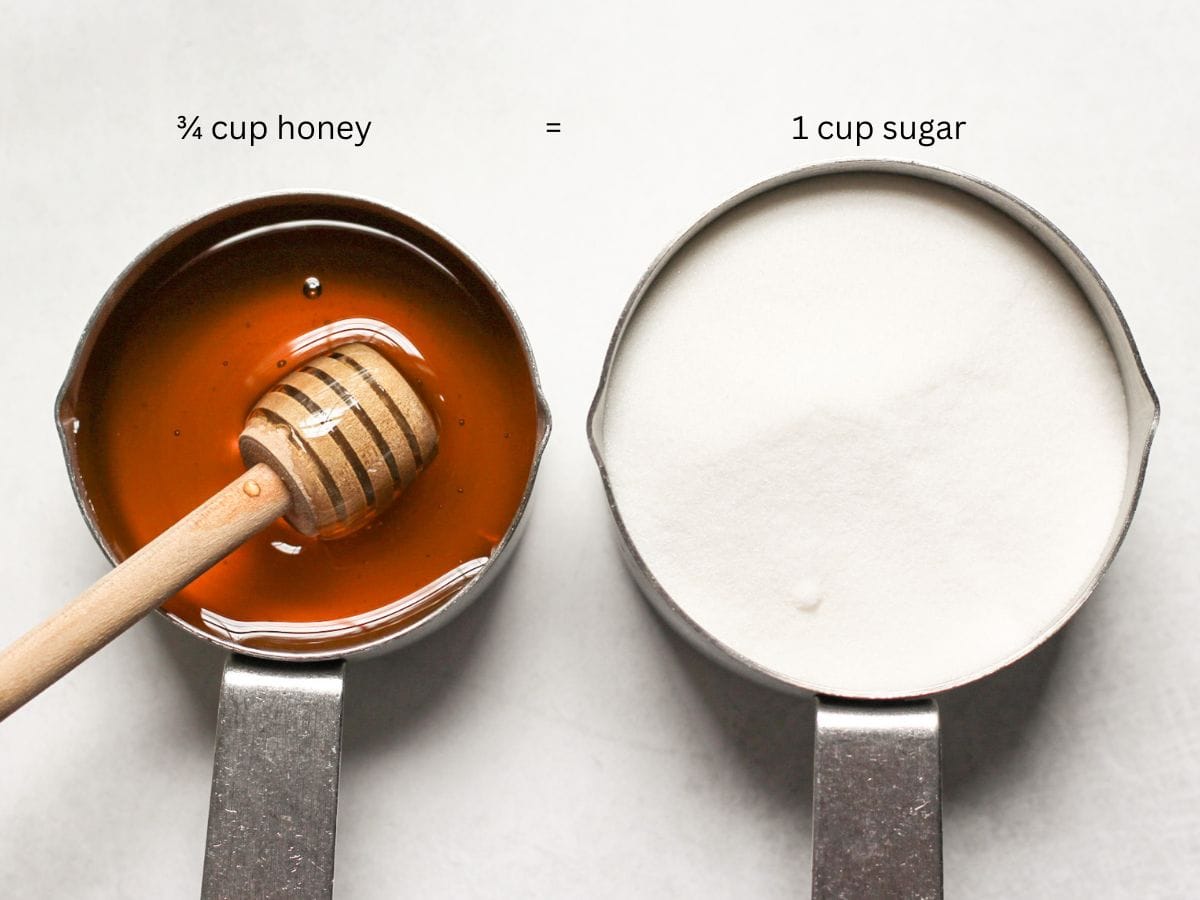
    Overhead view of two stainless steel cups showing the 3:4 substitution ratio: one filled with 1 cup of sugar, and smaller one filled with ¾ cup of honey,

    Which liquid to reduce when using honey?

    You probably looked at the chart above and wondered which type of liquid it is best to reduce.

    So for every 1 cup of honey, reduce the other liquids by ¼ cup.

    The best ones to reduce are milk, cream or water. If those are not part of the ingredients, you can reduce coffee, juice, pureed fruit. And the latest resort are the eggs. Eggs can be tricky to remove as they provide structure.

    Do not reduce oil, butter or other fats as are fats (not liquids) and play a big role in baked goods texture.

    The science here: Honey is sugar, not a fat. If you reduce the butter or oil to compensate for the liquid texture of honey, you are changing thee fat-to-flour ratio. This will make your baked goods tough and rubber.

    How using honey affects baked goods

    Using honey in baking changes not just sweetness. It also change the chemistry of your batter or dough. Because honey is a humecant, it naturally retains water. It means that your cakes will stay soft and breads will not get stale for loner days than those made with granulated sugar.

    Honey is also more concentrated than sugar, in simple words it is sweeter. It also adds a distinct flavor profile that can vary depending on the type of honey (wild flower, clover, buckwheat etc).

    Honey is made of natural sugars (fructose and glucose), so it triggers the Maillard reaction. It means that the baked goods will brown much faster. It results in deeper, golden-brown color and rich flavor, but it also means you need to keep an eye on the baking time to prevent over-browning.

    When Not to substitute honey for sugar?

    While honey is a versatile sweetener, it does not always work as a substitute for sugar. In some recipes, sugar is not just a sweetener, it is essential for structure. Here is when I think you should skip the honey and stick to regular sugar:

    • Crisps and crunchy cookies: If you are dreaming of snap-crisp ginger snap or a thin crunchy wafer, avoid honey. Because honey is humecant, it will not work for crispy and crunchy baked good.
    • Light and airy sponges: Recipes that call for creaming sugar and butter or beating eggs and sugar to create air pockets need sugar (not honey). Honey is liquid and cannot hold those air bubbles.

    Pro Tip: If you still want that honey flavor for such recipes, but need the structure, it is still possible. Try adding 1-2 tablespoons of honey and keep the rest of the sugar. This is exactly how I developed my honey sponge cake. By beating the eggs and sugar first to create that airy structure, and then gently mixing in that honey to flavor the batter.

    • Meringues and pavlovas: The stability of a meringue comes from the way sugar bonds with egg white proteins. Honey us simply too heavy and acidic for this process. The meringue will collapse if you use honey.
    • High-heat candy making: Honey has a lower burning point than white sugar. If you try using honey to make caramel or candy, it will likely burn.

    4 main rules for baking with honey

    If you do not have time to read through the whole article ( I know it is a lot), you can at least make sure to learn about the 4 main rules:

    1. The conversion ratio. Use ¾ cup of honey for 1 cup of granulated sugar.
    2. The liquid balance. For every 1 cup of honey added, reduce other liquids by ¼ cup. It can be milk, water, juice or eggs. Do not reduce the fats.
    3. Adjust the oven temperature. Lower your oven by 25℉ (15C). If the top browns too fast, cover it loosely with foil.
    4. The acidity. For every ½ cup of honey, add ½ teaspoon of baking soda to neutralize the acid and help the baked good rise.

    Frequently asked questions

    Can I use any type of honey for baking?

    Yes, you can bake with any type of honey. But keep in mind that the type of honey can change the flavor of your baked good. Clover and wildflower are mild and perfect for general baking. If you use dark honey like Buckwheat, the flavor will be stronger.

    Can I bake with crystalized honey?

    Absolutely. If your honey becomes solid or grainy, you can still bake with it. Make it liquid again (easier to measure!) by placing the jar in a bowl with warm for a few minutes.

    How do I stop honey to spot sticking to my measuring cup?

    Lightly coat your measuring cup or a spoon with the neutral oil and your honey will slide out easily.

    How to prevent my honey cake from browning too fast?

    Lower the oven by 25℉, bake at lower-middle position or cover the cake loosely with aluminum foil.
    My favorite baking with honey recipes

    • One-layer simple honey cake
    • Honey scones
    • Honey cookies
    • Honey banana bread
    • Honey sponge cake
    • Honey muffins

    More How to recipes

    • Dripping honey with honey stick over the slice of honey cake.
      How To Bake With Honey
    • Different types of homemade French fry cuts displayed on a cutting board: regular fries, crinkle-cut fries, steak fries, crisscross (waffle) fries, shoestring fries, and wedges.
      How to Make and Freeze Homemade French Fries (From Scratch)
    • A collage image showing different cooked foods in air fryer basket: chicken wings, Brussels sprouts. pear halves, asparagus.
      How to Use an Air Fryer+Favorite Recipes (From Immigrant Mom's Kitchen)
    • Fluffy buckwheat served in a white ceramic bowl on a tan kitchen napkin.
      How to Cook Fluffy, Perfect Buckwheat

    Comments

    No Comments

    Leave a Reply Cancel reply

    Your email address will not be published. Required fields are marked *

    Recipe Rating


    Sava's kitchen female author wearing an apron standing in the kitchen.

    Hi, I'm Nataliia, a mom from Ukraine living in the U.S. I share cozy, family-friendly recipes that taste like home, no matter where you are. I hope these recipes end up in your family’s recipe box someday.

    More about Nataliia →

    Readers Favorite

    • Air fryer frozen chicken breasts cooked to perfection, ready to serve.
      Air Fryer Frozen Chicken Breasts (Juicy, No Thaw Method)
    • Creamy blue cheese dip in a glass bowl. There is buffalo wings and celery on the side of it.
      Homemade Blue Cheese Dip For Chicken Wings
    • Baked lazy cabbage rolls in a bakiong dish.
      Ukrainian Lazy Cabbage Rolls
    • Tender whole boiled chicken in flavorful broth.
      How to Boil Whole Chicken (For Shredding and Sipping Broth)

    Footer

    ↑ back to top

    Sava's Kitchen

    • Privacy Policy
    • Terms and Conditions
    • Accessibility Statement
    • Contact
    • About

    Copyright © 2026 SAVA'S KITCHEN

    We use cookies on our website to give you the most relevant experience by remembering your preferences and repeat visits. By clicking “Accept”, you consent to the use of ALL the cookies.
    Do not sell my personal information.
    Cookie SettingsAccept
    Manage consent

    Privacy Overview

    This website uses cookies to improve your experience while you navigate through the website. Out of these, the cookies that are categorized as necessary are stored on your browser as they are essential for the working of basic functionalities of the website. We also use third-party cookies that help us analyze and understand how you use this website. These cookies will be stored in your browser only with your consent. You also have the option to opt-out of these cookies. But opting out of some of these cookies may affect your browsing experience.
    Necessary
    Always Enabled
    Necessary cookies are absolutely essential for the website to function properly. These cookies ensure basic functionalities and security features of the website, anonymously.
    CookieDurationDescription
    cookielawinfo-checkbox-analytics11 monthsThis cookie is set by GDPR Cookie Consent plugin. The cookie is used to store the user consent for the cookies in the category "Analytics".
    cookielawinfo-checkbox-functional11 monthsThe cookie is set by GDPR cookie consent to record the user consent for the cookies in the category "Functional".
    cookielawinfo-checkbox-necessary11 monthsThis cookie is set by GDPR Cookie Consent plugin. The cookies is used to store the user consent for the cookies in the category "Necessary".
    cookielawinfo-checkbox-others11 monthsThis cookie is set by GDPR Cookie Consent plugin. The cookie is used to store the user consent for the cookies in the category "Other.
    cookielawinfo-checkbox-performance11 monthsThis cookie is set by GDPR Cookie Consent plugin. The cookie is used to store the user consent for the cookies in the category "Performance".
    viewed_cookie_policy11 monthsThe cookie is set by the GDPR Cookie Consent plugin and is used to store whether or not user has consented to the use of cookies. It does not store any personal data.
    Functional
    Functional cookies help to perform certain functionalities like sharing the content of the website on social media platforms, collect feedbacks, and other third-party features.
    Performance
    Performance cookies are used to understand and analyze the key performance indexes of the website which helps in delivering a better user experience for the visitors.
    Analytics
    Analytical cookies are used to understand how visitors interact with the website. These cookies help provide information on metrics the number of visitors, bounce rate, traffic source, etc.
    Advertisement
    Advertisement cookies are used to provide visitors with relevant ads and marketing campaigns. These cookies track visitors across websites and collect information to provide customized ads.
    Others
    Other uncategorized cookies are those that are being analyzed and have not been classified into a category as yet.
    SAVE & ACCEPT